
FAQs - IRISH BANKING FRAUD & OTHER TOPICS
BANKING INQUIRY
PROTECTED DISCLOSURES REVIEW
Q: Did Senan Allen interview corroborative witnesses?
A: No
Please read the evidence (research) on this link
Q: Did Senan Allen research the Protected Disclosures related to the Central Bank of Ireland?
A: No
Please read the evidence (research) on this link
Q: Did the former Governor of the Central Bank, Mr Patrick Honohan, indicate that the Ms Morris’ Protected Disclosures were credible.
A: Yes! Following a face-to-face meeting with Ms Morris on 17 October 2015, Mr Honohan reported back to the facilitator of the meeting that the Protected Disclosures raised by Ms Morris were credible. He later alluded to the inadequate questioning of bankers in the Banking Inquiry in his book Currency and Credit published in ABC.
- Did testimony from any former Senior Executive of the Central Bank support Ms Morris’ Protected Disclosures?
A: Yes, testimony from Mr Frank Browne, former Head of Financial Stability, supported and aligned with Ms Morris’ Protected Disclosures, along the following themes:
- Evidence suppression & withholding of documentation
- Liquidity Risk Misrepresentation
- Regulatory Capture & Culture of non-transparency
- Impact on Banking Inquiry integrity
Q: Was the Ms Morris retaliated against by the Irish Civil Service?
A: Yes
Please read the examples here
Q: Was a false affidavit sworn by the Dail Clerk, denying such retaliation, filed in the High Court?
A: According to our research and review of evidence, there are clear examples of retaliation and as such, Mr Peter Finnegan, as Dail Clerk did swear a false affidavit and this was facilitated by either the State Claims Agency, or the law firm representing the Houses of Oireachtas, or both. The affidavit was concealed from Ms Morris for six years. This is evidenced.
Q: Did Ms Morris prepare a comprehensive rebuttal to the Senan Allen Report?
A: Yes. The response can be found here
Q: Did any Member of the Joint Committee of Inquiry refute the findings in Ms Morris’ response to the Senan Allen Report or indeed former Senator Marc MacSharry’s email 8 September 2015.
A: No
Q: The IMF (2016, 2022) & OECD (later in 2024) prepared reports on Ireland.
Was there ever a comparative report run comparing their results to the Ms Morris’ Protected Disclosures?
A: An AI generated comparison report was prepared and the summary is on this link.
In summary, while the IMF and OECD were not provided with access to Ms Morris’ Protected Disclosures, their findings did validate the themes Ms Morris raised:
- independence/accountability vs capture,
- under-resourcing,
- transparency/data gaps,
- sidelining of dissenting voices, and
- weak outcome measurement.
This demonstrates that Ms Morris’ Protected Disclosures were: accurate, reasonable, foresightful and aligned with global best practice.
Q: What is the background of Ms Morris?
A: Ms Morris is a Solicitor who qualified in Ireland in 1992 (non-practising as this time). She is also a Member of the New York State Bar (1995) and licensed in England & Wales (2005). Ms Morris was the former Head of Legal for Bank of Ireland Global Markets and GE Financial Markets. Both of these entities were clients of Ms Morris’ private practice.
Ms Morris’ specialisms are capital markets and derivatives law and she has provided services to numerous global banks, including Citigroup, Standard Chartered Bank and UBS.
Given her expertise and the frauds identified in the Bank Confidential Report, her professional reputation was required to be annihilated by Mr Senan Allen who was instructed to find no substance to Ms Morris’ disclosures.
The official transcripts demonstrate Allen’s lack of investigation into the disclosures and his disregard for interviewing corroborative witnesses. This is confirmed by a Joint Committee Member in communications to the Joint Committee.
BANK CONFIDENTIAL
The Bank Confidential Report was presented at The Palace of Westminster (13 November 2025) at an event coordinated by Transparency Task Force
Q: How significant is this BC Report? – “Interest Rate Swaps & Fixed Rate Loans, Hidden Credit Lines, Mis-Selling or The Largest Financial Fraud ever” – prepared by Bank Confidential
A: It describes the fraudulent sale of swaps by many banks in incredible detail and was endorsed by many financial experts, whistleblowers with the support of certain victims of the frauds.
Q: Was there a redress amount mentioned for victims?
A: The Financial (Times) Advisor referenced a sum of 50 billion pounds in their article
Q: Is there a concise summary of this Bank Confidential report?
A: The BC Report summary can be found on this summary link.
Q: Wil there be a back bench lead debate in Westminster on the issues raised?
A: Yes a debate has been approved
CENTRAL BANK OF IRELAND
REGULATION FAILURES
Q: Was the Central Bank of Ireland effective in regulating banks before and after the crash?
A: Independent testimony, including from former Central Bank official Frank Browne, indicates serious shortcomings in regulation — especially around liquidity risk and documentation transparency. This aligns with Ms Morris’ Protected Disclosures about suppressed and redacted evidence during the Banking Inquiry, as well as the suppression of crucial witnesses.
Q: Why were key documents withheld or redacted during the Irish Banking Inquiry?
A: According to Protected Disclosures and whistleblower accounts, internal Central Bank evidence was heavily redacted or simply not supplied to investigators, blocking a full understanding of risk supervision and regulatory failures.
Information around the bank guarantee decision in September 2005 was heavily redacted with evidence now emerging of certain banks disclosing to customers that they were in a liquidity crisis as early as 2005.
Q: Can the Central Bank of Ireland be held accountable for regulatory failings?
A: Victims and their representatives can file formal complaints, seek judicial review or pursue litigation.
COMMUNICATION (COMMENTS) FROM THE COURTS
Q: Is there a summary of the unique comments shared from the Irish courts?
A: Please click on these unique comments
COURT RECORDS
Q: Is it difficult to access court records?
A: Research indicates Courts and Court Services may generate misleading messaging or incomplete access to files, complicating efforts to obtain full and accurate documentation.
Q: How do I request copies of my court records?
A: Click on request copies for guidance and how to navigate potentially misleading messaging from the court services as they might try to deny your request.
DIGITAL ACCESS REPORT (DAR)
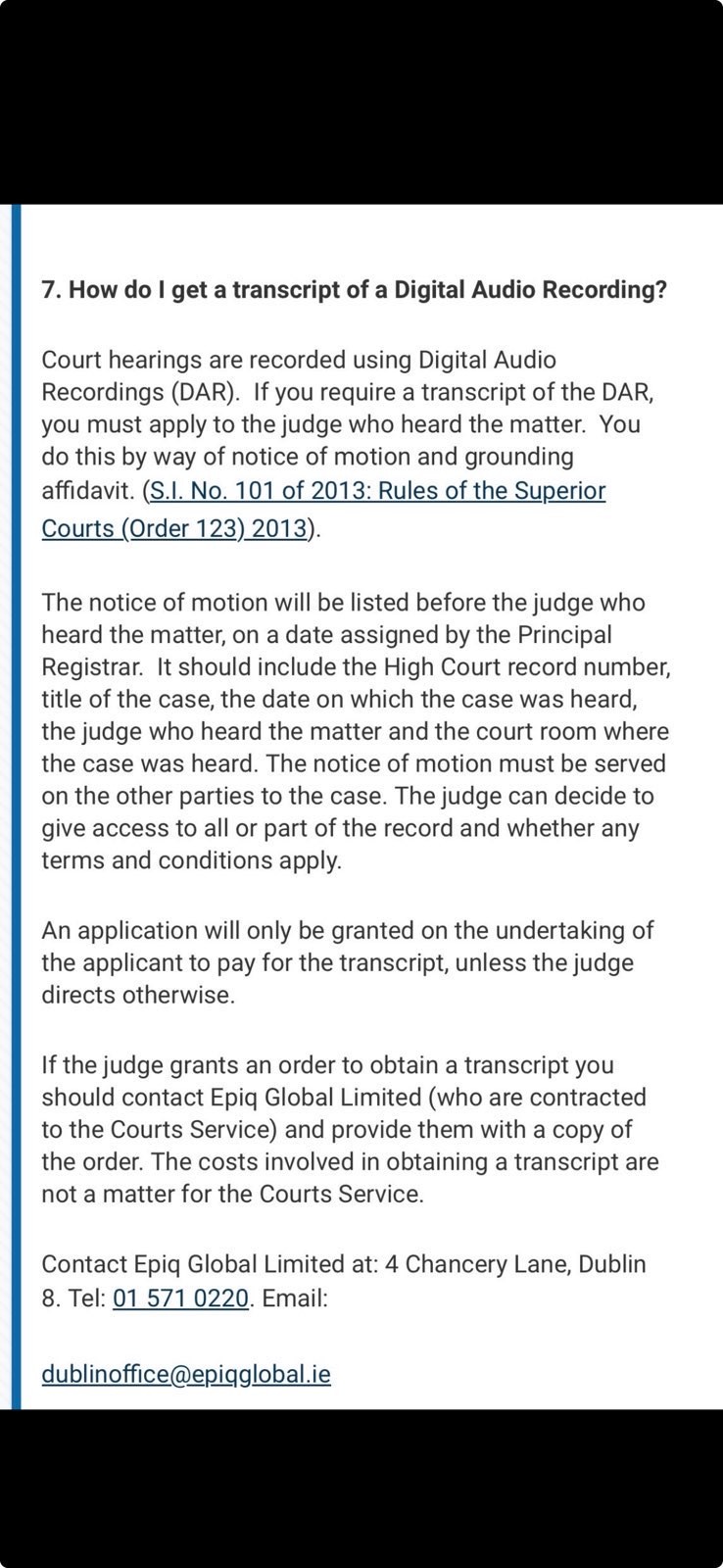
Q: How do I request a copy of my DAR from Court hearings in particular?
A: Click on this request a DAR link for guidance
GDPR
Q: What is GDPR?
A: In simple terms GDPR is a rulebook that says companies must be upfront about collecting your digital information (like names, emails, location) and must protect it carefully, giving you the power to decide what they do with it.
Q: How do I use GDPR and request my data?
A: Steps to Make a GDPR Request
- Identify the Controller: Determine which company or entity holds your data (e.g., social media, bank, online service).
- Find the Contact: Look for their Data Protection Officer (DPO) or privacy contact on their website, often in the privacy policy, or use their dedicated online portal.
- Draft Your Request (DSAR):
- Clearly state it’s a GDPR DSAR: Use phrases like “I am making a Data Subject Access Request (DSAR) under Article 15 of the GDPR”.
- Provide your details: Include your name, contact info, and any relevant account IDs.
- Specify what you want:Be as specific as possible (e.g., “all data from 2023,” “marketing emails,” “purchase history”).
- Mention the format: Request it in a common electronic format if possible (e.g., PDF, CSV).
- Submit & Verify: Send the request and be prepared to provide proof of identityto prevent fraud, as requested by the controller.
- Wait for the Response: They must respond within one month, though this can be extended by two months for complex requests.
Note: Readers should always do their own research and contact an expert. The professionals at Riar Ceartais Teo are an invaluable source of information and knowledge for many.
HIDDEN CREDIT LINES
Q: What is a hidden credit line?
A: The article on this link effectively theft is an insightful explanation from The Times as is the content in this video about Ulster bank fraud.
The Bank Confidential Report presented at the Palace of Westminster on 13 November 2025 is a forensic evidence-based report and a summary is available at this link.
HIDDEN LOAN DOWNGRADE
Q: What is a Hidden Loan Downgrade?
A: The following article at hidden Downgrade, describes what banks do when they need to reclassify your loan to seize it.
JUDGES & CONFLICTS
Q: Is there a scenario where judges hear cases in Ireland involving their former firms or clients?
A: Evidence suggests that conflicts, or perceptions of conflict, may exist in certain cases, especially relating to banks and their alleged assignees.
According to our research, certain judges have significant professional ties, yet self-recusal is rare and this presents enormous challenges for litigants. Indeed, there is resistance to recusal according to the research shared with us.
UNLAWFUL REPOSSESSIONS & PROPERTY RIGHTS
Q: Are unlawful repossessions happening in Ireland?
A: Reports, interviews and public testimonials suggest thousands of homeowners have had properties taken through court actions where lenders lacked standing, lacked complete or valid documentation, submitted false and misleading affidavits involving practices like forged signatures. In many cases, valid debt has not been proven.
Q: What can victims of unlawful repossession do?
A: Victims should retain all correspondence and loan files, seek independent legal advice, file complaints with the Financial Services and Pensions Ombudsman, and consider human rights or EU law challenges if national courts fail to protect property rights**
Many contributors recommend asking an adjudicating judge if s/he has read the unredacted documentation (evidence) so they at a minimum can establish bona-fides – especially legal ownership by the entity proceeding with the repossession actions.
LAW FIRMS REPRESENTING THE STATE
Q: Do these firms attempt to Delay, Deny & Destroy whistleblowers as described in the Irish Times, 13 May 2025?
A: Yes. The article, at this link for the Irish times is accurate
Q: Do the Partners of these law firms hide behind anonymity?
A: Yes, there is obfuscation.
Q: Do the Partners allow falsehoods in submittals to the Courts or in Position Papers?
A: Yes, they do in our opinion, and then of course, deny any wrongdoing. They are paid for by taxpayers.
Q: Do they follow the guidelines of the State Litigation Principles?
A: Not in our opinion. In fact, it is the direct opposite and this is being paid for by taxpayers.
Q: Who is the beneficiary of the Delay, Deny & Destroy litigation practice?
A: The law firms are the beneficiaries, as Mr John McGuinness, TD said eloquently in this speech. Those attempting to sustain a false narrative for the State are paid for by those at receiving end of false narrative.
The Human Cost of Speaking Out
LAW FIRM INDEMNITY COVERAGE
Q: If I want to put my law firm’s professional indemnity insurance carrier on notice of my concerns about the law firm I hired to represent me how do I contact them?
A: Please click on this link for a searchable function
LIBOR / EURIBOR SCANDAL
Q: What was the LIBOR / EURIBOR scandal
A: Major global banks colluded to manipulate the London Interbank Offered Rate (LIBOR) and EURIBOR, a key benchmark rate for trillions in loans, mortgages, and derivatives, between the mid-2000s and 2012, to profit from trading bets, to project financial stability during the 2008 crisis and low-balling led to triggers of LTV breaches for customers.
This activity led to huge fines, reputational damage and calls for major financial market reforms. The false borrowing costs submitted created an artificial rate that benefited the banks and served to make banks appear healthier, ultimately harming consumers and investors.
Q: What did the Central Bank of Ireland know about the LIBOR/ EURIBOR rigging?
A: No conclusions can be drawn at this time.
THE OFFICE OF PARLIAMENTARY LEGAL ADVISORS (OPLA)
Q: Was this Office ever legally constituted?
A: Many close followers of the House of Oireachtas say they were not. If any readers have evidence of the legal constituent of this powerful unelected, publicly unaccountable body, please email it to: contact@irldefrauded.com and we will post the evidence here.
STATE CLAIMS AGENCY (www.stateclaims.ie) the SCA
Q What is the SCA’s role?
A: Their role is summarized on this link
Q: Does the SCA collaborate with and direct law firms representing the Irish taxpayer?
A: It is unclear whether the SCA or the Attorney General’s office directs these firms due to the continued use of anonymity and lack of accountability in all signed documents and messaging between solicitors and the SCA.
STATE LITIGATION PRINCIPLES
Q: Are these principles closely followed?
A: No, they are not in our opinion
TRACKER MORTGAGE & CONSUMER RIGHTS
Q: What happened in the Irish tracker mortgage scandal?
A: The majority of Irish banks failed to honour customers’ contractual rights to tracker mortgage rates. The Central Bank’s Tracker Mortgage Examination found widespread failings that harmed tens of thousands of borrowers and led to fines and €683 million in redress — but many victims have yet to be compensated.
Q: Why did customers lose their tracker mortgage entitlements?
A: Investigations found banks mis-interpreted contractual terms, failed to warn customers of rate changes and didn’t apply lower tracker rates unless customers complained — resulting in thousands of customers being overcharged for years.
Q: What is the Central Bank’s Tracker Mortgage Examination (TME)?
A: The TME was intended to be a system-wide review of all lenders in Ireland that sold tracker mortgages. It required lenders to identify breaches and compensate customers where they failed to honour contractual tracker rates.
Q: Am I still entitled to compensation if I haven’t received it?
A: Even though the supervisory phase of the TME concluded in 2019, enforcement investigations continue and legal challenges or complaints can still be pursued. It’s recommended to contact an independent financial adviser and file a complaint with the Central Bank or Financial Services Ombudsman if you believe you were not fully redressed.
Q: How do I know if my mortgage account was impacted?
A: If you believe you were affected but did not receive communication, you should request documentation from your lender and seek independent review in our opinion.
NOTE: Many contributors believe this is an ongoing crisis and readers should do their own research with an independent financial advisor.
STATE FUNDED MEDIA
Q: Does the Irish State fund the media in Ireland
A: The govt funds significant amount to media groups
Q: Who funds these groups
A: The funds are through an entity called: Coimisiun Na Mean
Q: How much was funded in recent rounds
A: The significant amounts funded can be found in this link:
Q: What does this mean for reporting and investigative journalism
A: An opinion piece on this topic can be found at this link:
VAT FRAUD
Q: What is the VAT fraud we read about, especially in the chicken processing industry?
A: The article in the Mail on Sunday suggests that many chicken farmers, for example, were scamming the flat rate system to claim 1000% more VAT than they were entitled to.
WHISTLEBLOWER PROTECTION & RETALIATION
Q: What protections exist for whistleblowers in Ireland?
A: The Protected Disclosures Act 2014, as amended by the Protection of Disclosures (Amendment) Act 2022, implements the EU Whistleblowing Directive and provides for external reporting channels, confidentiality protections, and safeguards against retaliation.
Q: Why do whistleblowers still face retaliation?
A: Despite statutory protections, real-world experience — including state, civil service, and legal retaliation — shows that enforcement and cultural change lag behind the law.
Parliamentary debates highlight widespread failures in practice.
Q: What should I do if I’m retaliated against?
A: You should seek immediate legal advice, document all acts of retaliation (e.g., changes in duty, suspension, defamatory statements), and consider filing additional protected disclosures or judicial review applications to enforce legal rights.
NEWS / RESEARCH:
Please confidentially share any additional information or evidence that may benefit our readers to: Contact@irldefrauded.com
** This FAQ page is a guide only and is not meant to offer any legal advice. Please contact a qualified, independent solicitor for legal advice for any topic on this or our other pages. **